Privacy is important to us, so you have the option of disabling certain types of storage that may not be necessary for the basic functioning of the website. Blocking categories may impact your experience on the website.
Thank you! Your submission has been received!
Oops! Something went wrong while submitting the form.
Essential
These items are required to enable basic website functionality.
Personalization
These items allow the website to remember choices you make (such as your user name, language, or the region you are in) and provide enhanced, more personal features.
Marketing
These items are used to deliver advertising that is more relevant to you and your interests.
Analytics
These items help the website operator understand how its website performs, how visitors interact with the site, and whether there may be technical issues.
We use cookies and similar technologies to help personalise content, tailor and measure ads, and provide a better experience. By clicking OK or turning an option on in Cookie Preferences, you agree to this, as outlined in our cookie Policy.
China's EV Success: How Could the UK Re-Engage its Industrial Policy for Future Growth
December 18, 2025
When I first arrived in London from Beijing, the contrast on the roads was striking. In Beijing, electric vehicles (EVs) are not a futuristic novelty but a daily reality. In my neighbourhood in Beijing’s E-Town, an economic and technological development zone, the streets are filled with every variety of EVs -- saloons, SUVs, sportbacks, and even driverless shuttles gliding along dedicated testing routes. Charging stations are ubiquitous, while battery-swapping facilities are emerging as direct competitors to traditional petrol stations. In E-Town, humanoids robots are even taking part in half-marathons and boxing matches.
For someone accustomed to that environment, the dominance of petrol and diesel cars on the streets of Central London was jarring. At the same time, active protests on policies such as the Ultra Low Emission Zone (ULEZ) sparked an immediate question for a newcomer: how will the UK compete in an increasingly electrified world and achieve green and sustainable growth?
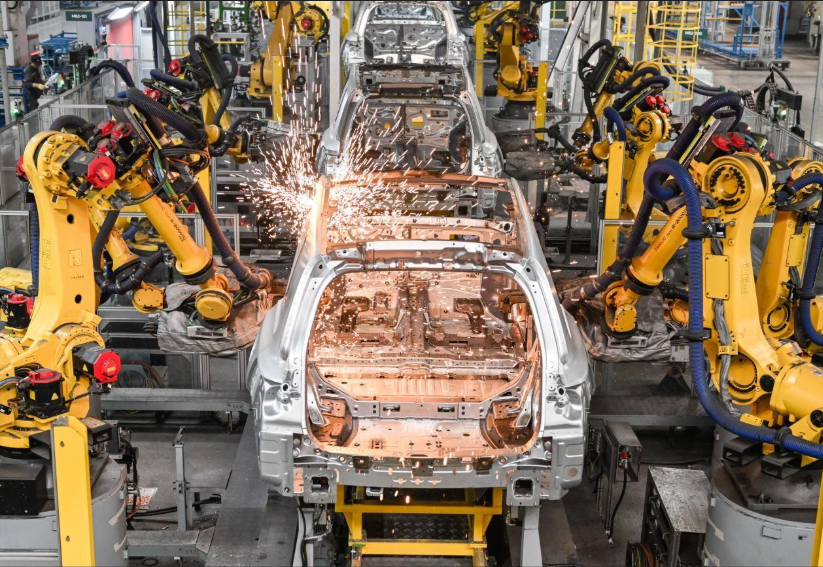
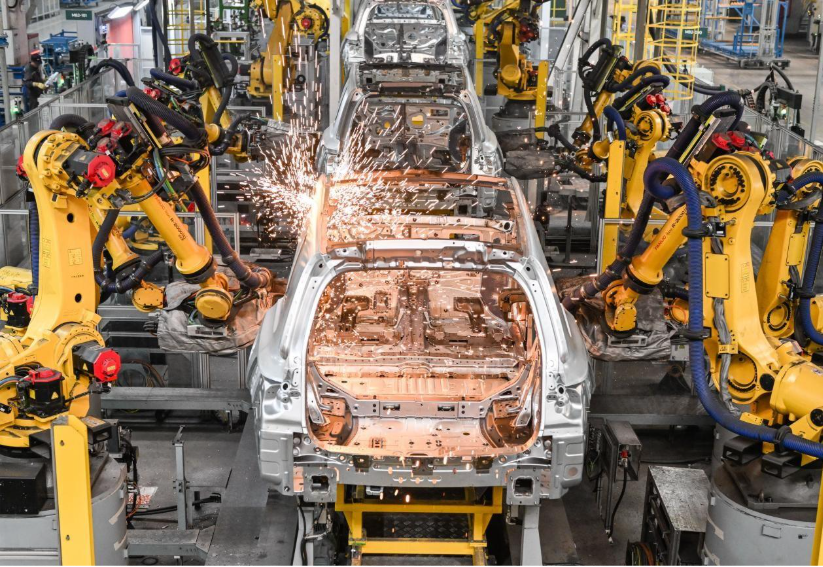
Robots weld bodyshells of cars at a workshop of Chinese electric vehicle (EV) maker Li Auto Inc. in Changzhou, east China's Jiangsu Province, Jan. 10, 2024. (Xinhua)
The UK first announced in 2020 its ambition to phase out fossil-fuel vehicles by 2030. However, whether viewed from the perspective of the EV industry or the domestic consumer, the gap between aspiration and reality remains wide. According to the Society of Motor Manufacturers and Traders (SMMT), the UK produced just 417,000 new cars and vans in the first half of 2025 -- the lowest figure since 1953. While the UK has avoided the industrial collapse seen in Detroit and the American rust belt, legacy brands are nonetheless facing severe challenges, with some factories at risk of closure.
These trends raise an urgent question that British policymakers could learn one or two from their Chinese counterparts for UK’s benefit: how did China’s EV industry evolve from being ridiculed by Elon Musk 10 years ago to becoming a global leader today? And more importantly, what lessons and opportunities could this hold for the UK’s own iconic automobile industry, with brands such as Range Rover, McLaren, Aston Martin, and Jaguar still commanding worldwide admiration?
China's Drive and Coordinated Policy Initiatives with Long-Term Thinking
China’s rise in the EV industry can be traced directly to a series of targeted policy initiatives. More than two decades ago, senior policymakers identified electric mobility as a strategic sector, linking it to both national energy security and long-term industrial competitiveness.
A key figure at the forefront of this vision was Wan Gang, China’s former Minister of Science and Technology. Trained in Germany and with professional experience at Audi, Wan recognised that China could not realistically compete with established Western and Japanese automakers in combustion technology. Instead, he argued, China’s strong and scalable manufacturing base could be reoriented and consolidated around electric vehicles for industrial upgrade.
From 2000s onward, Wan tirelessly pushed to place EVs on China’s mainstream political agenda. Despite scepticism at home, he maintained that prioritising EV innovation and accelerating the transition in transport energy strategy would enable China to enhance its industrial competitiveness in the global supply chain. In his words, this was China’s opportunity to shift from being simply a major assembly hub for global automobile brands to an industrial powerhouse leading on research and innovation.
The response was extraordinary: an unprecedented mobilisation of policy initiatives and resources across the entire EV supply chain. Support was channelled not only to carmakers, but also to firms specialising in batteries, rare-earth materials, software, and charging infrastructure. This coordinated policy push covering the full supply-chain, combined with market incentives and the scale of China’s domestic market, created fertile ground for experimentation and innovation. Fierce competition among domestic companies then accelerated the pace of technological breakthroughs and product development.
The results are striking. It took China nearly three decades to manufacture its first 10 million EVs. The next 10 million were produced in just 17 months. The question for Britain: could the UK replicate such rapid progress in a fragmented market environment, with more cautious consumers and inconsistent policy support? If so, how?
Industrial Clustering, Domestic Competition, and Global Cooperation
Industrial clustering, enabled by targeted policy design, robust investment, and division of labours across provinces, also helped to materialise China’s growth in the EV and relevant industries. Take the city of Changzhou as an example: through carefully crafted subsidies and strategically planned industrial goals, it has cultivated dozens of firms spanning every stage of the EV industry—from raw material processing to advanced control systems—creating efficient division of labour within a proximity that helped scale up key players across the EV supply chain without redundant competition.
The result has been a wave of technological breakthroughs. One of the central drivers of China’s lead in the EV sector lies in its ability to develop and supply advanced batteries. Companies such as BYD, CATL, and NIO now set global benchmarks in battery density, cost reduction, and charging speed. Once dismissed as gimmicks, innovations such as three-minute battery swaps are now becoming commercially viable thanks to sustained investment by private industry leaders and venture capitals. Crucially, these advances were not the product of state protection but of firm-level innovation, spurred by intense market competition.
This competitive environment is crucial. As Wan Gang predicted more than a decade ago, the sector evolved into a “survival of the fittest” marketplace where weaker players were forced out with stronger firms consolidating their product for a new round of fierce competition. Contrary to the rhetoric that Chinese EV companies thrived under protectionist shelter, many brands in fact collapsed under domestic market competition despite strong backers. Jiyue, supported by Geely and Baidu, and Neta, backed by 360 Group, are notable examples of top venture-funded firms now struggling. At the same time, China actively welcomed international competition: Tesla’s Shanghai Gigafactory, for instance, was not treated as a threat but as an opportunity to cultivate a new generation of global-facing Chinese automakers.
Employees work at the Tesla Gigafactory in Shanghai, east China, Nov. 20, 2020. (Xinhua)
The result is a highly dynamic market where Chinese EV companies compete vigorously on product quality, pricing, and after-sales services, optimising resources along the supply chain while delivering tangible benefits to consumers. The synergy of strategic policy planning, the scale of China’s domestic market, market dynamism, and open competition has produced globally competitive Chinese EV brands.
A Hesitant and Unclear Strategy in the UK
By contrast, the UK government’s policy approach to EVs could see drastic improvement, which now leave both consumers and manufacturers uncertain about the country’s long-term trajectory. A recent £650 million grant scheme promised up to £3,750 off an EV purchase, but in practice, as reported by The Times, few models qualified for the full discount. Dealerships complained that the scheme created confusion in pricing and sales strategies, which in turn discouraged consumers. As a result, private buyers account for only one-fifth of EV sales, with the rest driven by fleet purchases.
At the industrial level, infrastructure remains a critical bottleneck. A Royal Society of Chemistry survey in June found that nearly two-thirds of UK drivers lacked confidence in the government’s ability to deliver sufficient charging capacity by the 2035 deadline. The collapse of Britishvolt, a start-up once valued at £800 million, that promised a gigafactory but never produced a single large-scale unit underscores the challenges – lack of a large common market and the capacity to ensure sustainable production. While brands such as Jaguar and Lotus have begun proactively pursuing an EV strategy, most British automakers lack a comprehensive electrification plan, further hindering progress and momentum at an industrial scale. The industry finds itself caught between the gravitational pull of EU industrial policy, the uncertainty of post-Brexit Britain, and the absence of a consistent domestic industrial strategy.
The pressure on policymakers in the UK is therefore acute. The EV sector has already demonstrated its potential to create jobs, accelerate the energy transition, and deliver sustainable growth. For a country with a deep industrial heritage in automotive manufacturing, failing to capture this momentum would represent a profound missed opportunity. Strengthening the EV sector could help revive the UK economy and provide high-quality jobs in a time of global uncertainty. More importantly, the UK’s world-class universities and research institutions can supply the brain power and technological talent required. The key task for policymakers is to build a bridge that connects this knowledge base with industrial capacity through targeted and coordinated planning.
Lessons to Achieve Long-term Benefits for the UK
One of the central lessons from China’s EV success is that a coherent industrial policy not only supports domestic integration and healthy competition, but also shapes long-term consumer preferences and builds public support. For the UK, the challenge is not a lack of capacity but a lag in comprehensive policy strategy that can withstand global competition, welcome healthy global cooperation, and cultivate a strong domestic market.
With London’s iconic electric double-decker buses are now produced by BYD and the TX5 black cab manufactured by the London EV Company (LEVC), a Geely subsidiary, have proven collaboration with international brands is good for attracting investments, creating jobs, and generate growth prospect in the UK. The LEVC case is particularly instructive. Geely invested £480 million to develop the TX5 model, establishing a factory in Coventry that has sustained thousands of domestic jobs for more than a decade. This is a clear demonstration that collaboration with Chinese and global automakers can yield long-term economic and environmental benefits.
Pragmatic Approach Moving Forward
Recently, Octopus Energy, the UK’s largest energy supplier, introduced an all-inclusive car-and-charging bundle that includes a leased electric vehicle, a bi-directional charger, and a smart tariff with BYD. This package enables vehicle-to-grid (V2G) charging, combining Octopus’s expertise in virtual power plant (VPP) technology with BYD’s advanced EV and battery systems. For British consumers, the benefits are clear: savings of nearly £1,000 compared to running a petro car, alongside reduced dependence on fossil fuels and lower pressure on the grid during peak hours.
At the consumer level, sales data show that British buyers are increasingly receptive to Chinese EVs, drawn by their affordability and quality. According to SMMT, overall car sales declined by 5 percent in July, including a 59 percent drop of Tesla sales, while BYD’s number tripled to 3,200 units during the same period.
For what the UK policymakers should utilise is to have Chinese automakers regard Britain as more than a profitmaking opportunity, which will attract the companies to invest to the UK. The British market offers these companies a gateway to global visibility and international competitiveness. Such dynamic underscores an important reality: UK policymakers and business leaders will benefit by engaging constructively with Chinese EV companies, and should move beyond the mindset of a zero-sum framework of competition.
China’s success in building a world-leading EV industry was neither accidental nor straightforward. It was the product of a long-term vision, coordinated industrial strategy, and a willingness to embrace competition and global cooperation. For the UK, the lesson is not to replicate China’s path, but to adapt these principles pragmatically to Britain’s own strengths: its legacy of automotive excellence, world-class universities, and globally influential financial markets. If policymakers act decisively to empower domestic industries, support businesses, and encourage consumers, the UK will not only safeguard its automotive sector but also secure a leadership role in shaping the future of sustainable industrial growth and the energy transition.
No items found.
Written by:
Wencheng Gao
Journalist and commentator of Xinhua News Agency; Associate Contributor, The 48 Group