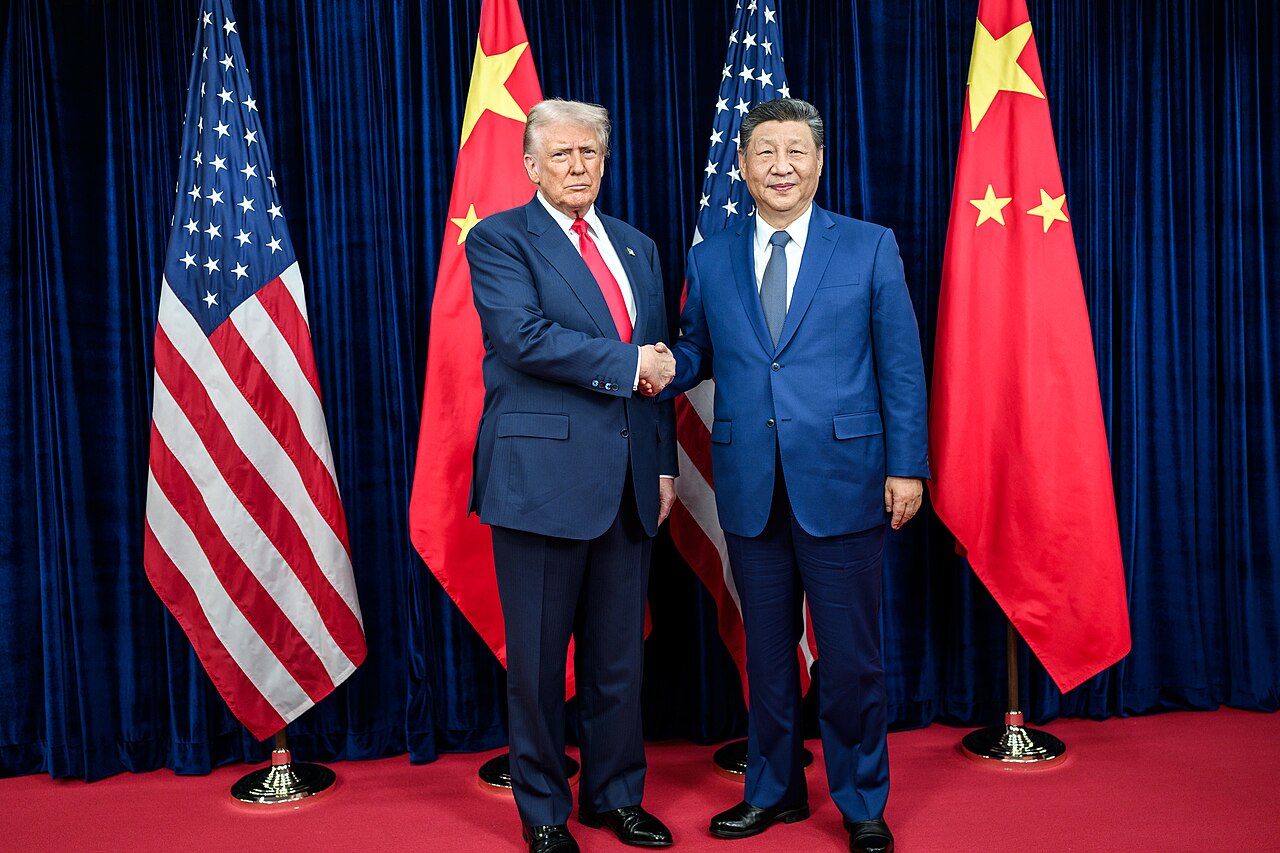
The state visit of President Donald Trump to China carries great significance for global economic stability. Since Trump’s inauguration in 2025, the world’s two strongest economies have been mired in an unproductive trade war, with high tariffs negatively affecting not only the US and Chinese economies but also the global economy.
For Britain, within its growth agenda, there is a real opportunity. Prime Minister Keir Starmer’s visit to Beijing allowed many trade deals to be secured for British businesses, and UK-China relations to be re-engaged. Following King Charles’s state visit to the US, where tensions with Trump were eased and tariffs relaxed, the UK can seek to profit from an easing in US-China relations. If the US and China can relax their tensions, perhaps the whole world economy, and subsequently the UK’s, will grow.
What may lead to the easing of these tensions is that the US no longer seems to be in a position of strength to strong-arm China or other economies economically. The international context of the failure of Trump’s tariffs to sufficiently boost the US economy, and global economic instability due to international conflicts demonstrate a trend of distrust in the US hard power.
The US-Iran conflict, coupled with constant battles in Ukraine and the Middle East, has led to a global oil, energy, and gas crisis, with the Strait of Hormuz closed, sanctions on Russian resources, and the Gulf states in panic. Due to this global economic instability, initiated in part by Trump’s arbitrary foreign policy, this state visit could be the catalyst to cool tensions and ease pressure on the global economy.
Where the UK should look to benefit
According to the Office for National Statistics, the UK economy grew by 0.3% during March, the month after the Iran war. This could be viewed as a success considering the context, but in reality it is not enough. The UK finds itself in a tight economic spot, with many of its assets under private management, a strained relationship with the EU, and no access to the single market due to Brexit, while energy prices shoot up because of international conflicts through no fault of the UK. Therefore, the progress of achieving an eased US-China relations, and subsequently a reboot in global trade, provide a real opportunity for the UK to achieve economic growth.
Both China and the US are abundant in natural resources and are advanced in the world of technology, areas of vital importance and current potential for the UK. Through the UK’s ‘special relationship’ with the US and the easing of US-China tensions following the state visit, the UK could hope to achieve a deal on natural resources. Considering the recent re-nationalisation of British Steel, the UK could seek to utilise its own natural assets to trade resources with China and the US in order to boost growth, employment, and stability.
The UK could pay reference to China’s and other Asian economies’ public ownership through state-owned enterprises in certain key industries while keeping well-performing sectors private. The UK could embark upon a nationalisation programme of its energy, water, rail, and natural resources. Some may argue that the best way to grow an economy is to have a manufacturing base, and the UK arguably does too little manufacturing. By potentially nationalising its industries, the UK can take greater control of its economic growth.
Furthermore, with China and the US leading the way in the digital economy, data, robotics, and the burgeoning low-altitude economy, an easing in tensions can facilitate growth in these fields for the UK. With an easing in US-China relations, there could be trade in microchips and eVTOL technology, as well as data-sharing arrangements between the US and China. The UK could look to benefit from this development to boost its own technological capabilities.
Taiwan and Tech
A key sticking point in the US-China relationship that has come up during the state visit is the issue of Taiwan. President Xi Jinping stressed to President Trump the potential for conflict over the region. Importantly, Taiwan is a hub for microchips, which are a valuable resource in the ever-growing digital economy. If the US and China can de-escalate tensions regarding Taiwan and build a fruitful relationship, the risk of conflict will fall and international economic stability will rise. This is significant for the UK, as a key ally of the US: if there were to be any conflict over Taiwan, the US would almost certainly try to pressure the UK to get involved.
While the Cold War was marked by an arms race between the US and the USSR, perhaps the ongoing trade war between the US and China will be marked by a tech race. The digital economy of AI, data, robotics, microchips, eVTOLs, and more are no longer secondary ambitions for nations, but primary ones. China and the US are very much embroiled in a race of technological development, which only highlights Taiwan’s strategic importance, and with President Xi’s restated determination on reunification, along with President Trump’s strategic ambiguity, there is a need to maintain a strong US-China relationship to prevent conflict and instability.
The UK has a strong talent pool in the world of tech, but no strong infrastructure to support it. Many of its start-ups and graduates are snapped up by US and Chinese businesses and universities, where there are greater funding and more resources available. With competitiveness in tech rising between the US and China, the UK should seek to leverage its talent pool to procure tech-related investment into the UK from China and the US, rather than simply having its talent poached.
Changing international stability
Much of economic prosperity is influenced by global stability, and stability is often damaged by threats to security. China and the US are the world’s two most powerful nations and naturally influence global security. Therefore, with tensions between the US and China eased, China may persuade its ally Iran into a ceasefire and open the Strait of Hormuz to ease international trade. Furthermore, with the world’s two leading powers acting as partners rather than rivals, realist international theory may have to reassess itself, and the world could move towards a more cooperative international future.
As is often the case with international relations, things can change very quickly. With stability being the currency of the hour, the governance of the UK and the US is rarely stable and is always changing. This stands in direct contrast to the stability of China’s political system. If the UK ties itself to a Chinese-US trade deal, there is always the possibility that it could collapse overnight due to the irregularity of President Trump’s policy decisions, whether online or in person. Therefore, the UK should be wary of attaching itself too closely to any trade deals between nations with conflicting political systems.
Following the US state visit to China, the introduction of a new global order feels apparent. Still within the realms of realism, the modern age seems to prove that national security and economic security go hand in hand. Therefore, realism is no longer a security-based political theory but an economic one, and while globalisation is unlikely to make the US and China partners and allies, it can make them rivals whose priority is mitigating instability for their own economic benefit. Economic security is the new national security, so stability becomes the currency of power, not strength.
For the UK, the US state visit to China, operating as a mission of stability and normalising relations between the two powers, no matter how ceremonial, is beneficial—not only for the economic potential but also for the feeling of security that a partnered China can bring. With scepticism of China often high in the UK over spying fears, a stable China-US relationship will soften fear of China and allow for a fruitful economic relationship between the UK and China.
Conclusion
The UK should look to establish greater trade relations with the US and China in light of the US state visit to China, but it should not make concrete commitments to whatever deals are agreed because of the risks of instability. Ultimately, the relaxation of tensions between China and the US can only bring benefits to international trade and the UK, with advancements in technological capabilities on the horizon that should be pursued.
To conclude, the US state visit to China is a prime opportunity to de-escalate international tensions and alleviate economic strains brought about by the US-China trade war. If tariffs are reduced and trade deals are agreed, then there is the possibility of further US-China cooperation that could affect global security and help to end conflicts such as the Iran war. It can be argued that there are only benefits to be gained for the UK as a result of US-China cooperation.
Overall, the easing of US-China relations can strongly benefit the UK’s growth agenda, as many of the causes of the UK’s economic issues lie in international instability, and the two world powers easing tensions would relax the international economy. What the UK needs is to strengthen its own industry and infrastructural capabilities while having energy costs brought down through the easing of international tensions.
The views and opinions expressed in all writings are those of the authors and do not necessarily reflect the position of The 48 Group.