Privacy is important to us, so you have the option of disabling certain types of storage that may not be necessary for the basic functioning of the website. Blocking categories may impact your experience on the website.
Thank you! Your submission has been received!
Oops! Something went wrong while submitting the form.
Essential
These items are required to enable basic website functionality.
Personalization
These items allow the website to remember choices you make (such as your user name, language, or the region you are in) and provide enhanced, more personal features.
Marketing
These items are used to deliver advertising that is more relevant to you and your interests.
Analytics
These items help the website operator understand how its website performs, how visitors interact with the site, and whether there may be technical issues.
We use cookies and similar technologies to help personalise content, tailor and measure ads, and provide a better experience. By clicking OK or turning an option on in Cookie Preferences, you agree to this, as outlined in our cookie Policy.
Growth in Transition: China's Rise in Robotics Industry and Synergies for UK-China Collaboration
March 2, 2026
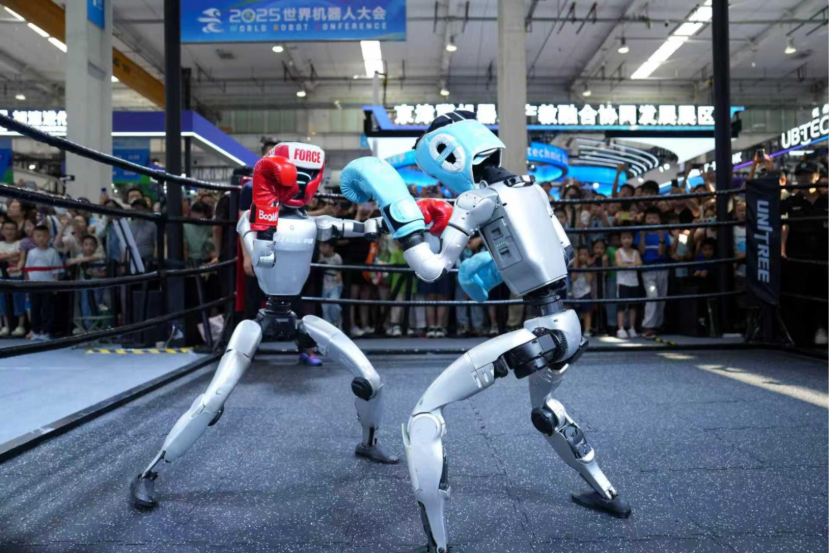
During the 2026 Spring Festival Gala, China's most-watched annual television event, domestically developed humanoid robots performed martial arts routines, comedy sketches, and synchronized dances. What once appeared experimental now seemed strikingly mature, with video clips going viral on global platforms such as Instagram, Facebook and YouTube. Their rapid progress not only impressed Chinese audiences but also drew global attention, signaling that robotics has moved from laboratories into mainstream industrial usage and social life.
These performances are more than a technological spectacle; they highlight China's growing position to lead the next phase of advanced manufacturing and embodied intelligence. As Boston Dynamics' display of the seamless movements of its Atlas humanoid robot also went viral online, it highlighted how artificial intelligence (AI), robotics engineering, and real-world application systems are finally converging. As countries around the world compete to shape the future of automation, China has emerged as a leader in global supply chains, technological innovation, and the commercialisation of robotics.
As the United Kingdom searches for new ways to revitalise innovation and stimulate growth, policymakers and businesses are seeking to seize the opportunities of the Fourth Industrial Revolution to generate long-term benefits for the country.
Behind China's vivid public demonstrations lie a vast ecosystem supported by a complete industrial supply chain, expanding application scenarios, and coordinated industrial policy. From recognising robots as "revolutionary products" at the national level to major venture capitals and state-led industry funds investing heavily across the supply chain of the industry, robotics is increasingly viewed as a strategic engine for long-term economic growth.
China's robotics expansion aligns with its broader economic transition toward an innovation-driven growth model. Humanoid robots, in particular, sit at the intersection of AI, advanced manufacturing, and intelligent automation - sectors expected to define global technological competitiveness in the 21st century.
According to the World Robotics 2025 report released by the International Federation of Robotics (IFR), China's operational stock of industrial robots surpassed 2 million units in 2024, the highest in the world. Robots are now widely deployed across automotive manufacturing, electronics, metal processing, healthcare, education, and household services, gradually transitioning towards practical tools used by industries and consumers alike.
Collaborative Innovation and a Rapidly Expanding Ecosystem
A defining feature of China's robotics rise is its model of collaborative innovation, in which government institutions, research organisations, and private capitals jointly accelerate technological development and commercialisation.
Rather than relying on isolated university-level research, humanoid robot training is treated as a systematic engineering effort combining simulation environments, large-scale data collection, and real-world testing. Since 2022, at least eight national or regional innovation centres dedicated to humanoid robotics and embodied intelligence have been established across China.
Shanghai hosts the country's first heterogeneous robot training facility, where more than 100 robots operate simultaneously across industrial and domestic scenarios, generating large datasets essential for machine learning. National platforms using reinforcement learning have shortened the development cycle for robotic skills from weeks to minutes in virtual environments before transferring them to physical machines. Open-source datasets and motion-control frameworks further reduce industry entry barriers, enabling faster commercialisation.
The sector's growth is reflected in economic data. China's Ministry of Industry and Information Technology reports that the robotics industry revenue reached nearly 240 billion yuan in 2024, while revenue in the first half of 2025 grew 27.8% year-on-year, with industrial robot production reaching 370,000 units.
Importantly, China's robotics boom extends beyond humanoid machines. Industrial robots remain the backbone of manufacturing automation, while service robots, with extensive use in logistics, healthcare, hospitality, and home environments, are becoming a major growth frontier because it is easier to deploy them on scale.
Revenue from China's robotics industry surged 29.5% year-over-year during the first three quarters of 2025, outpacing expectations as the country produced 595,000 industrial robots and 13.5 million service robots, both exceeding the full-year totals for 2024.
Government support has also encouraged regional specialisation and constructive competition. Beijing focuses on core components and commercialisation, Shanghai aims to build a global innovation hub, Zhejiang nurtures AI-driven robotics firms, and Jiangsu targets breakthroughs in key technologies such as robotic control systems. Even smaller cities leverage resource advantages to build specialised robotics clusters, forming a nationwide innovation network.
Industry projections suggest 2026 could mark a turning point for mass production, with domestic humanoid robot shipments potentially rising from about 18,000 units in 2025 to more than 60,000 - or even higher under optimistic forecasts. Decreasing costs are accelerating commercialisation, supported by China's strong manufacturing supply chain and localised production of core components.
While the United States maintains advantages in foundational algorithms, China's strength lies in scalable manufacturing and supply-chain integration, enabling rapid iteration and cost reduction. This complementary technological trajectory shapes global competition as well as opportunities for cooperation.
Global Expansion: Competition, Localisation, and Cooperation
Chinese robotics companies are gradually entering overseas markets, turning globalisation into a central development strategy. Industry observers note that humanoid robots are inherently global products: domestic manufacturing maturity and supply-chain efficiency combine with strong international demand, particularly in regions facing labour shortages.
More than ten Chinese firms have already deployed humanoid robots in pilot programs across Europe, Southeast Asia, the Middle East, and North America. Applications currently focus on education, research, exhibitions, and controlled commercial environments, while broader industrial and household adoption remains under development.
Export expansion, however, presents challenges. Companies must navigate certification standards, data governance requirements, cultural adaptation, and long-term service expectations. Experts emphasise that successful internationalisation requires a "country-specific strategy," adapting products to local regulatory systems and consumer preferences.
Localisation is becoming central to global competitiveness. Overseas deployment allows robots to learn from diverse environments, improving algorithms and accelerating technological maturity. This is where an opportunity is presented to UK businesses and policymakers to conduct beneficial engagement on this front. As the Chinese companies need collaboration with international partners, including joint manufacturing exploration and research cooperation, to participate and succeed in the global market.
At the same time, service robots are quietly reshaping everyday life worldwide: cleaning hotel facilities in North America, assisting restaurants in East Asia, maintaining public spaces in Europe, and performing household tasks for families across multiple regions. China's ability to combine AI capabilities with cost-efficient hardware manufacturing has strengthened its competitiveness in these consumer-facing applications.
Opportunities for UK-China Collaboration in Robotics
The global robotics transition creates significant opportunities for cooperation between China and the UK. The UK now faces lack of productivity growth, labour shortages, and shattering supply-chain across manufacturing and service sectors, areas where research and commercialisation of robotics industry could deliver immediate economic value.
According to projections by Morgan Stanley, the humanoid robot market could surpass $5 trillion by 2050, on the strength of one billion units sold, encompassing manufacturing supply chains as well as maintenance and support services. Separate estimates suggest that up to 80 million humanoid robots may be operating in households worldwide, underscoring the scale at which robotics could reshape productivity, labour markets, and service delivery.
Against this global trajectory, evidence indicates that the United Kingdom faces an adoption gap. A joint report by Make UK and Sage finds that Britain currently deploys 112 industrial robots per 10,000 workers, approximately half the European Union average, ranking 24th globally in robot density. This lag raises broader questions about industrial competitiveness and long-term productivity growth.
In this context, engagement with China's rapidly expanding robotics ecosystem may present practical opportunities. China's strengths in large-scale manufacturing, supply-chain integration, and deployment experience could complement the UK's comparative advantages in research, advanced engineering, and innovation governance, suggesting potential pathways for targeted cooperation alongside continued strategic competition.
The UK's Modern Industrial Strategy (2025) further strengthens the potential for international collaboration in robotics. The strategy includes £4.3 billion in investment for advanced manufacturing over five years, of which £2.8 billion is dedicated to robotics and automation research and development, alongside a pro-innovation regulatory environment designed to support rapid commercialisation. Together, these measures position the UK as an attractive destination for robotics research, testing, and commercialisation partnerships.
Concerns about safety and data security, often raised in discussions of advanced automation, can be addressed through transparent standards, certification systems, and joint regulatory frameworks. Robots operate within programmable and auditable systems, making compliance measurable and manageable when international technical standards are aligned.
Beyond trade, deeper cooperation could emerge in several areas: AI algorithms and embodied intelligence research, high-end manufacturing and smart factories, healthcare and elderly-care robotics, green automation supporting net-zero goals, and shared standards for safety, ethics, and interoperability.
China's strength in upstream manufacturing, including actuators, motors, sensors, and precision components, combined with the UK's research excellence and regulatory innovation, could create complementary advantages rather than purely competitive dynamics.
Robotics and the Future Global Economy
Robotics is rapidly becoming a defining technology of national competitiveness and economic resilience. The next generation of intelligent machines promises higher productivity, improved public services, and better working conditions for UK workers.
China's robotics development demonstrates how large-scale markets, coordinated policy, and industrial ecosystems can accelerate technological adoption. Yet the future of robotics will not be shaped by one country alone. As automation reshapes global production and daily life, international collaboration, alongside competition, will determine how safely, efficiently, and inclusively this technological transformation unfolds.
For countries like the UK, engagement with China's robotics ecosystem offers not only economic opportunity but also a chance to participate in shaping the norms and applications of one of the century's most transformative technologies.
No items found.
Written by:
Wencheng Gao
Journalist and commentator of Xinhua News Agency; Associate Contributor, The 48 Group
Zeng Yan
Journalist and commentator of Xinhua News Agency; Associate Contributor, The 48 Group