What is the low-Altitude economy
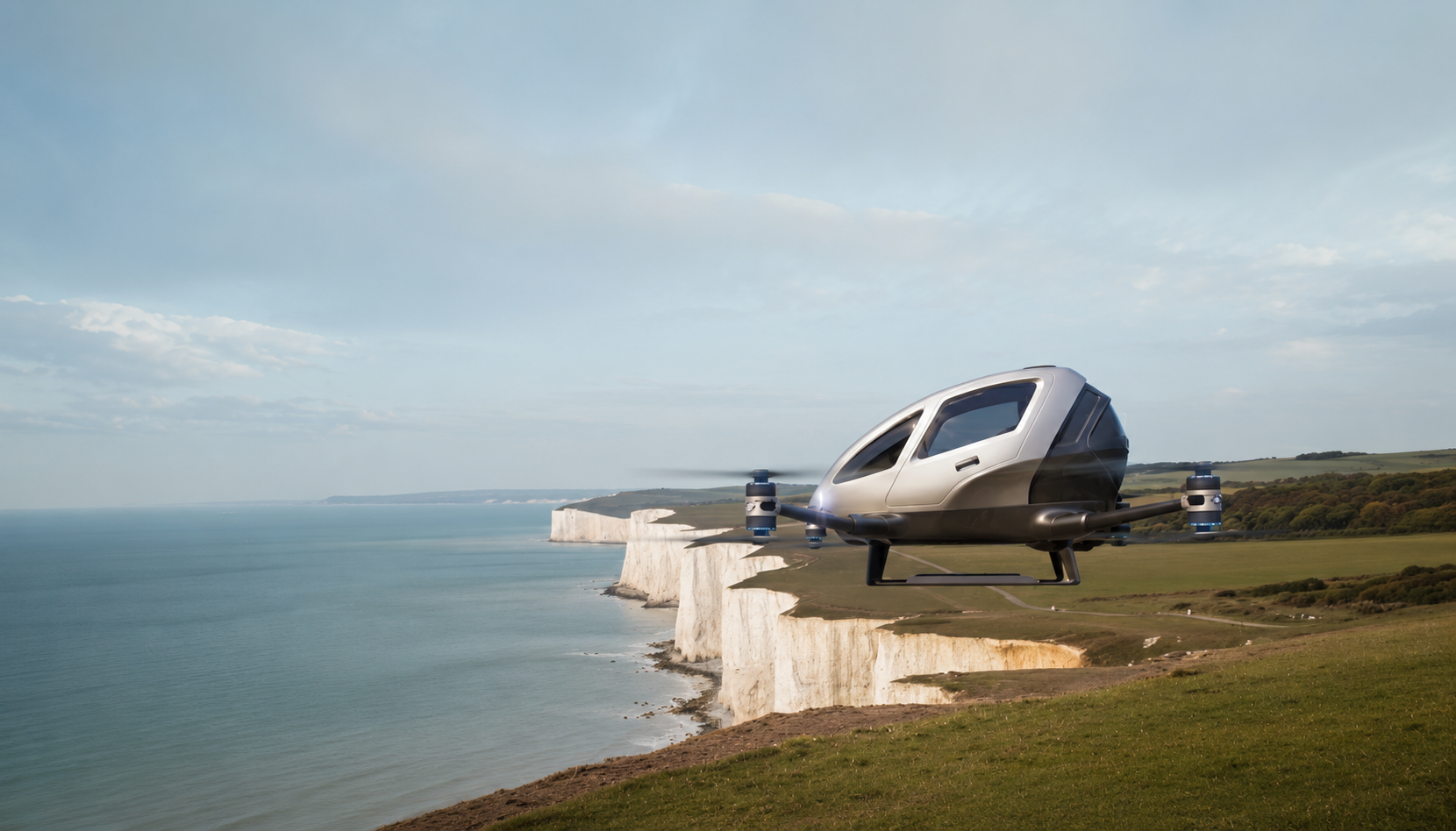
The Low-Altitude economy (LAE) can be considered a groundbreaking acceleration within the developing digital economy. The Low-Altitude economy could revolutionise services, transport, healthcare, AI and Tech as well as every facet of daily life. The Low altitude economy is an emerging economic sector which executes commercial operations and services in airspace below 1000 metres above ground level. It seeks to achieve this through technological advancements in aircraft, infrastructure and traffic management- particularly through drones and eVTOLs (Electric Vertical Take-Off and Landing). The key uses for the Low Altitude economy include passenger transport, cargo delivery, emergency response, tourism, surveillance and agriculture. Overall, the LAE can be considered a key advancement in how business and public services are conducted.
Benefits for the UK
The development of the LAE provides ample opportunities for the UK in business and policy to help growth within the UK economy. Firstly, the UK receives over 40 million international visitors each year, making tourism a huge contributor to the UK economy. The LAE offers an opportunity to boost the money made through tourism, through tourist specific transport shuttles within London, tourists can pay mid-level to premium prices to enjoy flying tours of the city. Furthermore, the UK has the opportunity to develop tech related tourism drivers similar to Japan who draw many tourists through the appeal of their futuristic robotic attractions. Secondly, through drones prescription medication can be delivered to vulnerable patients, and important equipment can be seamlessly transferred hospital to hospital via eVTOLs and vertiports.
Furthermore, the LAE can provide paths for the UK to accelerate its approach to net zero and go green. While not perfectly renewable yet, eVTOLs and drones produce far less carbon emissions than traditional modes of transport. By using the LAE to transport goods domestically, carbon emissions can be reduced- helping the environment. Also, if air-taxis can be developed, which can carry multiple passengers, there will be less of an inclination for people to travel by car, increasing public transport usage along with eVTOL usage to aid the environment.
Learning from the Chinese application
The LAE is thriving in China in comparison with the UK and the rest of the world. China is comfortably leading the way, with much of the world stuck in the certification or development stage of the LAE, China is comfortably in the commercial deployment phase. China’s regulatory speed is a key reason for this advanced development, the CAAC fast-tracks certifications for domestic manufacturers, enabling Chinese manufacturers to get ahead of the curve in developing the LAE. Furthermore, the market deployment of the LAE in China is growing with the eVTOL EHang 216 flying 15,000+ passengers through 2024-25, while drone deliveries operate at large scale for delivery companies such as Alibaba. The strength of China’s LAE is motivated in part by the huge market size, which exceeds the entire global market. Furthermore, the entire industry receives mass government support, with regular commitments made in the Five-Year plans- thirty provinces implemented dedicated low-altitude economy policies.
This industry wide support generates a large manufacturing scale which enables China to dominate the global market, building thousands of aircrafts and vertiports, allowing the LAE to thrive in China. Therefore, with government backing and a strong manufacturing base with a wide market, China can initiate strategic implementation of the LAE while western companies are still in certification. There is a lot for UK businesses and policymakers to learn from China for the LAE to thrive in the UK.
Further application for the UK, growth, services
Further opportunities for services and economic growth for the UK lie within the development of the LAE. Firstly, if the UK invested and developed fully the LAE, it would become a global leader in the digital economy, which would present huge economic benefits for UK growth. Through strength in the LAE, comes strength in tech, AI, Data, manufacturing, transport, production and trade- the UK would become an attractive trade partner for nations with similar tech levels while also being a point of reference for those developing their tech. It can be argued that the LAE will become vital for a nation’s security, the UK’s security industries could be greatly strengthened through the LAE. In the Russia-Ukraine war, drone warfare has become the status quo on the battlefield, it stands to reason the future of warfare and national security lie in drone and eVTOL capabilities.
Furthermore, the LAE presents chances to strengthen the agricultural industry in the UK. High costs are frequently spent on heavy farming machinery which are hard to operate, the LAE presents the chance for smaller machines to assist in irrigation, cattle feeding, farm surveillance, security from predators after livestock and more. The LAE also presents farmers with an environmentally friendlier way to transport goods and produce to wholesale purchasers. Ultimately, the LAE could potentially revolutionise the agricultural industry for the UK- which is pertinent considering the strife which UK farmers constantly find themselves in. With the UK worried over its carbon emissions due to the intense car travel, the LAE could be an addition to public transport and reduce the reliance on cars while offering an alternative to tubes and trains for those who do not like them.
Potential risks and barriers
Like all groundbreaking developments, there are barriers to overcome and potential risks to be wary of. Firstly, there is a technical obstacle- the operational capabilities of various eVTOLs are not perfect, there are issues which need addressing. Current batteries do not last much longer than an hour and their current distance range is only at 100 miles, 200 miles short of what is required. However, these technical deficiencies will most likely be solved as the research and manufacturing increases in development. Furthermore, there are infrastructural issues within urban spaces that need addressing when validating eVTOLs for launch as well as enabling communication to and from the machines. The weather is a factor that many in the industry view as a threat, right now many of the eVTOLs cannot cope in harsh weather conditions like strong winds and rains, which are frequent occurrences all over the globe.
There is also a regulatory obstacle to overcome, which can be surmised as an issue of airspace integration. There is no regulation concerning the daily integration and segregation of thousands of eVTOL flights as well as pre-existing aircraft traffic. There is no regulation regarding liability frameworks if accidents were to occur, as well as regulation regarding privacy due to the surveillance threat which eVTOLs and drones can present. A key reason for the wide deployment gap between nations is because of the regulatory gaps between nations, for the LAE to thrive universally, there must be transferable universal regulations which allow each nations manufacturing and development base to thrive- there are too many organisations setting too many regulations.
Perhaps the most pertinent risks and barriers are economic ones. The key issue lies in the cost per seat ratio, current cost-per-seat runs $100-200+ but needs to drop to $30-50 to compete with ground transit. It doesn’t work at scale until the prices fall but the prices won’t fall unless scale is achieved. Infrastructure costs are high, vertiport investments require billions in global development and the insurance costs of the entire industry are still being developed. Finally, there is a lack of a skilled workforce- a shortage of operators and engineers restricts growth, the talent pipeline will take years to develop, and scale cannot be achieved without the talented workforce to support it.
Finally, social resistance might prove the most difficult barrier to overcome, the strength of the local community will not take kindly to mass change which the LAE would bring. If costs cannot be brought down for ‘air-taxi’ usage, then the product will draw resentment from working commuters who cannot afford it, the product will become a vehicle for the rich which will increase class divisions and societal disunity. Community opposition will also be focused on noise pollution, if the products cannot reach a quiet enough volume, then community lawsuits will be likely- this will happen in every major city and will become a divisive political issue. In order to mass charge the many machines, the energy grids will require more funding which will lead to a rise in energy bills which would increase social resistance. Finally, with the increasing capabilities of AI and data, the threat of hacking and cybersecurity increases. With thousands of eVTOLs in low altitude spaces within international cities, the threat of hacking and potential terrorist attacks are high. To prevent this, there will need to be stringent investment and resourcing of cybersecurity networks which of course, will increase costs.
UK-China collaboration
Following Prime Minister Sir Keir Starmer’s state visit to China, there is an opportunity to further strengthen UK-China relations through trade, especially through the low altitude economy. With China in the commercial deployment stage of the LAE in a nationwide capacity, the UK should look to trade more with China in this field to develop its own LAE. With a strong partner in China, the UK’s economic growth could exponentially drive upwards through the development of the international LAE with the UK being a leader. The LAE would create job opportunities in a wide range of fields, strengthening employment and supporting growth.
Conclusion
The LAE is the latest development in the growing digital economy and carries huge significance for global and British businesses and international public services. It is a revolutionary industry with plenty of benefits available for the UK. Healthcare, transport, security, the environment, agriculture, tech, trade and tourism are all key industries and services which could benefit hugely from the integration of the LAE into the UK economy and public life.
Overall, it comes with its risks and its obstacles to be overcome, but it can be said that the LAE is the future of commerce, domestically and internationally- the technology should be invested in and supported. The LAE presents an opportunity to strengthen international relations for the UK with China, and in our unstable world, that could be a welcome opportunity to begin to stabilise international relations.